sábado, 7 de abril de 2012

AUTHOR QUOTES


"I think there will come a time when the ruins
of corruption will rise the splendid morning
emancipated world, free from all evils,
of all monstrous anachronisms of our
time and our outmoded institutions "

Samuel Fielden

miércoles, 4 de abril de 2012

COUNTRY SPAIN AMNESTIES


Much has happened since Miguel Boyer in 1984 with the first tax amnesty decreed in democratic Spain, its purpose, get put in the box from the public purse some of the millions that the wealthy classes, once the leaders had escaped the control of the estatepublic, which in those days, in which the Spanish banks in banking secrecy still existed, or when there was no VAT (value added tax), this amnesty was a slight push of black money to the battered chests, by buying Treasury promissory notes in a tax, in addition to providing the acquirer of anonymity, something unthinkable today if you look coolly, but pardonable, if you consider that there are many things in those days like today, were and remain well bound, although this would not be the last time a socialist government would declare an amnesty, as in 1991 when he was finance minister Carlos Solchaga, offered to redeem their money fraudster black, by promissory notes denominated treasury, public debt, especially with an interest rate below market, in any case these measures filled the expectations.

The next time and the last in which a socialist government would raise this possibility, it was in 2010, at the height of the economic crisis and two years ahead of the elections, to a brutal lack of liquidity, this time with Zapatero head of the executive, raise it meant that the then opposition leader Mariano Rajoy tachase of occurrence and Maria Dolores de Cospedal, now general secretary of the popular party, the measurement tachase antisocial.

After the brief history of tax amnesties in Spain, to paraphrase Mr. Rajoy the tachare of occurrences, the first things I ask myself is, is it ethical and moral in a time of cuts amnesty to tax fraudster?, I think not, since they will benefit from this amnesty, has been uncooperative with the other citizens, has benefited from the services we provided the state that has disappointed and probably belong to the wealthy classes of this country, and this seen from my perspective, as a simple taxpayer who is exposed to an error on your statement will pose a huge fine for my microeconomics, is not acceptable to me taught me that stealing has consequences and the state has to be there to enforce thelaw.

I also wonder what has changed so that the occurrences of Zapatero, measures are now bright?, In my opinion the only thing that has changed is the political color of government, before ruling on the left, and now rules the right, a right demagogic and hypocrite who has a speech and lacking changing goals we undoubtedly will lead to nowhere, a government that in the words of finance minister emphasizes that the first is the deficit, the second is the deficit, and the third is the deficit, forgetting that this country is made up of flesh and blood people form with their daily work, the GDP of this country.

But worst of all, the occurrence of the government to raise between fraudsters, who will collect an estimated 2.5 billion euros, forecasts very positive if you consider that you can not encrypt the intention of the fraudster, as can we know with certainty that the money will emerge?, in my opinion and not venture your opinion means to me, like buying a lottery ticket and hope that tap to pay the mortgage next month.

However emerge before the millions of black money to the executive Rajoy problems arise to carry out its announced tax amnesty, as the Basque Country and Navarre have already said they will not apply saying something obvious, which has to do is chase the fraudster.

To conclude that I am not in favor with the tax amnesty because I consider unjust and unjustifiable in economic crisis, in which the majority must tighten their belts, the fraudster paying 10% to go scot-free with money has defrauded the public finances, it is educational and useful for citizens allow tax fraud and there is less to amnesties that serve to maintain the status of life of people who say they are the wealthy classes of this country.

Antonio Garcia Leal ®

THE SOLUTION WILL BECOME THE PROBLEM


The state budgets # PGE, leave us a whole string of cuts which together account for 27 billion euros, a synthesis of these cuts leave a scenario where not free any citizen outreach public service, reducing healthcare 6.8 % Social spending was 4.3%, Education 21.9%, 15.1% Cultural, Environment 31.2%.
This steady reduction in public spending, aims to reduce the budget deficit to 5.3% EU taxation and markets for Spain not intervened, these measures, taken together success can kill us, because if Although Spain may end up meeting these deficit targets, the contraction in public spending will generate unemployment, offset by reforming the labor market predicts that the government itself does not create jobs and leaving unshielded the working class of this country for good and evil is what sustains the whole system, plus the apparent lack of liquidity among small and medium enterprises that largely prevent the creation and support of employment, a lack of liquidity that banks can not resolve the injections of money selling EU compared to 1% to 5% to the administration to provide liquidity to Royal Decree-Law 4/2012 which will be used by the local government pay their suppliers and that in turn will help providers indebted banks pay for this, which only makes banks a windfall, generates the ideal breeding ground for the whole package that straitjacket our public expenditure policy and the measures to reform the labor market does not serve at all to get us out of the crisis, but rather to keep Spain in the crisis for longer.

So we should ask where is the magic wand wielding Mariano Rajoy when he was in opposition, and claimed to be the solution to bring the crisis to Spain? In campaign promise to be the only reliable alternative to pull the country out of crisis, Now with his measures after 100 days in office is leading the Spanish locomotive without lights through that tunnel in which we got greedy bankers and inept politicians who failed to manage the wealth that generated the housing bubble, and we failed to invest that money to build the foundations of future economic growth of this country and those powders come sludge.

The course taken by many bodies Rajoy politicians leave in their wake, and several generations of citizens living dead.

Antonio Garcia Leal ®
https://www.facebook.com/tatarlak
https://twitter.com/ #! / tatarlak

sábado, 31 de marzo de 2012

THE MAKESHIFT OCCURRENCES OF DON MARIANO


The disaster is served, in the form of budget, more social cuts, corporate tax increase, and last but not least the brilliant "occurrence" of the executive led by Rajoy, tax amnesty for fraudsters.

This is the way out of economic crisis, we mark the executive, supplemented by a labor reform that does not create jobs in 2012, which is forecast this year to increase by 630,000 more unemployed, that leaves workers unprotected against employers, which seems more than satisfied with this reform and now openly pit the reform of the law to strike to finish demolishing the rights of workers, a royal decree to provide liquidity to local authorities endowed with 35,000 million, serves that while providers charge administration, although the first charge will be willing to grant amnesty to the administrations of the debt, is starting against the government into debt with the banks receiving loans at 5% interest while you get the money from the ECB at 1%.

While all this happens in less than 100 days of the Popular Party and mediated a general strike by the complete lack of dialogue between the unions and the government's plan for tax fraud not submit it until after Easter, and financial market reform, partly responsible for this economic crisis by their overweening greed do not hear, neither tells us what happened to hundreds of thousands of small investors who purchased the preferred options of the same banks that receive money from ECB 1% and sells it to local governments to 5%, a bank than to buy bankrupt entities receive 900 million euros of public funds, a bank that has not stopped ever make a profit and announced with great fanfare .

And the city government gets translated into a strong slap more taxes, cut public services and lower quality, but at a higher price, and no medium-term solution to end the crisis.

To top it all off corruption scandals continue monopolizing the media, the case Urdangarin, Matas case, the plot Gürtel or if you show the decay of the system and show us a really hard to take, our coffers are empty, and a few pockets are full, to counter this corruption, the transparency law, a vague idea to curb the disastrous management that has led us to this disaster to make it closer to the citizen, is subject to the suggestions of this through a website - I did the mine the following this link you can see - or code of ethics to force banks to accept in cases of extreme misery to payment in kind, as the fighting platform evictions considered insufficient.

I would like to close this article by saying that I find it regrettable executive hypocrisy of Mr. Rajoy, who in 2010 had no doubt that the amnesty proposed by the Zapatero government, "it was an occurrence" or the lady of the crossed out Cospedal "measure antisocial" and now poses as a brilliant idea to get us out of the crisis, that's just us two years private income which could at least have helped the public coffers were fuller, with its grim attitude in the opposition have led to this disaster and are as responsible for this situation, as are the governors, so the worst of all this absurdity of measures is that down the road to all that will serve is to make the poor poorer and the rich richer, for the small saver preferred options for the fraudster great tax break.


 "This is not to societies in which we
all equal, let alone, to destroy what
built to create something different,
it is simply to create a society
where we are all equal;
as we balance the scales "


Antonio Garcia Leal ®
https://www.facebook.com/tatarlak
https://twitter.com/ #! / tatarlak

lunes, 19 de marzo de 2012

BICENTENNIAL OF THE CONSTITUTION OF THE COURTS OF CADIZ 1812 - 2012


"The first step that tyrants have always
to enslave the people is the prohibition of writing
and speaking in order to achieve by this means that the
men did not have a language contrary to their ideas
tyrannical and ambitious, more precisely in this way
to be rather frank and educated citizens,
slaves hypocritical and stupid. "


Álvaro Flórez Estrada

(Reflexiones sobre la libertad de imprenta, 1810)

lunes, 12 de marzo de 2012

BATTLE OF THE EBRO


The Battle of the Ebro (Spanish: Batalla del Ebro, Catalan: Batalla de l'Ebre) was the longest and bloodiest battle of the Spanish Civil War. It took place between July and November 1938, with fighting mainly concentrated in two areas on the lower course of the Ebro River, the Terra Alta comarca of Catalonia, and the Auts area close to Fayón (Faió) in the lower MatarranyaEastern Lower Aragon. These sparsely-populated areas saw the largest array of armies in the Civil War. The results of the battle were disastrous for the Second Spanish Republic with tens of thousands of dead and wounded, with little effect on the relentless advance of the Nationalists.


Museo de la batalla del Ebro


Ver Museo de la batalla del Ebro en un mapa más grande


Antonio Garcia Leal ®


lunes, 27 de febrero de 2012

BICENTENNIAL OF THE CONSTITUTION OF THE COURTS OF CADIZ


The constitution that the courts of Cádiz promulgated on March 19, 1812, led to the enlightened society of the era who embodied Jovellanos, Saavedra, Cabarrus, Melendez Luis de Urquijo to a new state political liberalism, which would serve to political axis savior of absolutist doctrines governing the Bourbon Spain at that time.

That declining imperial Spain, invaded legally by the
Treaty of Fontenebleu and delivered to the emperor in the abdication of Bayonne, was lack of a king, but not notable citizens, willing to write in his name a constitution that would endow the Spanish from both hemispheres something as simple yet necessary for the progress of society, that they give itself, a fair legal framework on building prosperity and thus the prosperity of the kingdom, this legal framework was the constitution of the Cortes of Cadiz 1812, a constitution within the range of thought of the time, stated in Article 1 that the Spanish nation is the gathering of the Spanish people of both hemispheres, and in its Article 3 he gave to the nation, only the right to establish fundamental laws, this release is that sovereignty rests with the people and although Article 14 provides that the form of government is a hereditary monarchy moderate, Articles 15, 16, 17 implemented the necessary separation of powers so that the society of the time needed to progress.

Article 14. The Government of the Spanish nation is a moderate monarchy hereditary.

Article 15. The power of making laws resides in the Cortes with the King.

Article 16. The power of executing laws resides in the King.

Article 17. The power to enforce laws on the causes lies in civil and criminal courts established by law.

The legal framework created by the constitution of 1812, gives civil society of the time a fairly solid base on which to base the creation of a society, fairer, freer and more democratic, and that it shows in the Title 3, which deals with the issue of election of deputies, they shall be elected by universal male suffrage established in Articles 88 and 89, but does not advance the rights of women, something that did not happen or Spain, or in other parts of the period until 1838 in
Pitcairn are the Republicans would endow 119 years after the woman's right to vote in Spain in the constitution of 1931

Article 88. Will proceed at once by voters who are present at the election of the Deputy or Deputies, and shall be selected one by one, approaching the table where he is the president, the scrutineers and the secretary, and he writes in a list, to their presence, the name of the person who everyone chooses. The secretary and the scrutineers will be the first to vote.


Article 89. After the vote, the president, secretary and tellers will make the regulation of the vote and will elect the one that has met at least half the votes plus one. If no one should have an absolute majority of votes, the two who have had the largest number come in second ballot, and shall be elected who meet plurality. In case of an equality of fortune, and made the choice of each, the President issued.

The figure of the king is free of liability and is inviolable, and so on artículo168 reads:

Article 168. The King's person is sacred and inviolable, and not subject to liability.


But the privileges, powers and restrictions of the King, are reflected in Articles 170, 171, 172, where although Articles 170 and 171 give the King among others, the power to issue decrees, regulations and instructions; declare war, or make and ratify the peace, to appoint the judges of all civil and criminal courts, armies and navies send or appoint generals, Article 172 submits to the authority of the courts stating that the king can not, under any excuse holding the courts, where the sovereignty of the nation can not leave the kingdom, abdicate, create alliances, sign treaties levy taxes, grant privileges to entities or persons, deprived of his property, detain or impose penalties or so if you want to marry without the consent of the courts.

With the exception of Article 168, which gives the king of the inviolability and to relieve them of responsibility, the monarch was reduced to represent the country, something very similar to the current situation of the monarchy in Spain and has a sticker Article 168 in Article
56 paragraph 3 of the 1978 constitution. The oath which binds the king with the 1812 constitution implies to preserve and defend the Catholic religion not to alienate, assign or dismember any part of the kingdom, and not requiring any amount of money ever except that the courts had decreed for person. Being all written in Article 173.

The different ministries that make up the government are set out in Articles 222 to 230 through the clerks office, which exercised the king's ministers, but are accountable to the courts.

The creation of the State Council, made up of 40 individuals from all social strata from which they must have, 4 and 4 large church of Spain, who have distinguished for his learning and knowledge, will be chosen by the king to proposal the courts, has the function of advising the king on the serious issues asolen the nation.

With respect to the courts and justice, Title V of the constitution of the Cortes of Cadiz addresses a profound democratic reform and justice, sheltering in Chapter I the much needed separation of powers in Article 242, which in its wording makes clear that the responsibility of enforcing laws, belongs exclusively to the courts, in Chapter II, Article 280 establishes the right to all citizens without distinction, to go to court to settle their differences.

The main aspects of Chapter III, have a clearly marked goal of eradicating the Spanish justice, the system used by the
Inquisition to dispense justice, Section 303 prohibits the Torment, who had given so many false confessions to the inquisitors; the 300 requires that within 24 hours to manifest, the treaty as the cause of prison inmate and the name of his accuser and the 301 will be given the information specified in Article 300, which is opposed to the inquisitorial system that did not indicate the defendant or the reason for the arrest or who accused him.

Articles 304 and 305 prevent the confiscation of property, which the Inquisition to the inmate for defrayed the cost of staying in jail, ends the defendant is guilty or innocent, or that the penalties imposed on a person transcend the rest of the family.

Chapter IX in regulating public instruction, Articles 366 and 367 provide for the creation of primary schools, which teach children to read, write and count, create universities, 370 public education becomes in free and which gives the courts the creation of plans and special statutes to cover the amount.

Section 366. In all the peoples of the monarchy be established primary schools, which will teach children to read, write and count, and the Catechism of the Catholic religion, which shall include a brief statement of civil obligations.

Finally, the Article 371, gives the Spanish freedom to write, print and publish their ideas without a license, review or approval, prior to publication, thus eliminating the censorship, which for centuries had practiced inquisition, to control the ideas in Spain, with the approval of the crown accomplice, celebrities are the indexes of books prohibited by the Holy Office.

But the constitution of the courts of Cádiz not address religious freedom as one of the pillars on which to build democracy in Spain, perhaps because ¾ of the members belonged to the clergy, and this made it difficult to carry out a draft constitution covering this freedom, winch also noted that the society of the time was deeply Christianized by centuries of Catholic indoctrination, even so, it created conflicts between the clergy and the civil power emanating from the constitution because of the early intervention of the civil power on the priest,
Pedro de Quevedo Bishop of Ourense and board member of the supreme board, refused to sign the constitution, which is a highlight, as is the first confrontation between the civil and clergy, in the history of Spain This battle cost the courts decided to deport him.

Abolition of the Inquisition was hard and heated debates in the chamber, but in the end January 5, 1813 Cadiz courts abolished. But after the return of Fernando VII in 1814 the Inquisition was restored, its abolition was held by
royal decree on April 17, 1834, with Queen Elizabeth II daughter of Ferdinand VII, but being ruled Spain Maria Cristina of Bourbon-TwoSicilies; as regent.

Article 12 establishes in perpetuity the Catholic, Apostolic, Roman and throughout the text mix religion with civil life, even in the election processes of public office, so do the teaching, in Article 366 which states that, "was taught to read, write and count, and the Catechism of the Catholic religion."

But not only some sectors of the church were against the constitution, also had detractors among the
defenders of absolutism, who wanted a return to Spain of Ferdinand VII. The absolute, freedom of the press used to accuse liberals of bringing more extreme ideas of the French Revolution in Spain, these irreconcilable differences led to the chamber labeled fragment into two sides, the absolutist and the Liberals, the first defending the back to the old regime, a society in which clergy and nobility were privileged classes were led by the King who was the senior figure in front of these were the liberals who wanted to impose a political partner fairer, more just and more democratic.


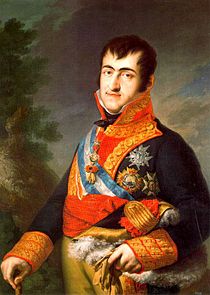
On December 11, 1813, by Fernando VII
Valençay treaty was recognized as king of Spain by Napoleon Bonaparte, although the treaty was not ratified by the regency, the courts expected the king to swear allegiance to the constitution of 1812 that they could recognize his authority.

Fernando VII,  entered Spain in Valencia on 16 April 1814, there met with a representative of Regency expected to swear to the constitution, and a representative absolutist with a
document of Persia The manifesto, signed by 69 deputies absolutist, which Cadiz courts rejected the April 17 General Francisco Javier Elio, put his troops at the disposal of the monarch to regain power, was enacted on May 4 by a royal decree which declared null and void the decrees of the courts of Cadiz, which was dissolved on May 10.

Its dissolution, would seat the old regime and the crown of Ferdinand VII, on a fragile foundation, which over the years not only were crumbling, but in the end broke triggering, military coups, the Carlist wars or the proclamation of the first and second Republic among other historical events that shook the history and people of the country, all these events although it would seem that are unrelated to each other, has a thin but visual thread, that is, without doubt, the lack of future expectations Spanish people so miserable greed and unbridled power of some characters.

Spain who had a golden opportunity to end the nineteenth century as a parliamentary monarchy, developing that constitution which may well be the starting point to build a new Spain of all by all and for all, a theme only briefly see the light in 1931 with the proclamation of the second republic, but that would be drowned in blood the April 1, 1939 with the victory of the coup led by General Franco, who imposed a criminal dictatorship that lasted 40 years.Today we are still building our future and developing the 1978 Constitution, a constitution of all by all and for all, democratically, we have to finish a good tool to cement our democracy, only requires touch-ups and dyes that each want to put within the framework of democracy and freedom.

"200 anniversary of the establishment of courts of Cadiz
By and for those who fought died and went in the name of freedom and democracy in Spain "

I, republican
Castilian version of the article


Antonio Garcia Leal ®
https://www.facebook.com/tatarlak
https://twitter.com/ #! / tatarlak